Seamless Fire and Camouflage Patterns
In the realm of digital design and physical manufacturing, finding a visual language that commands attention while maintaining professional cohesion is often a balancing act. Seamless Fire and Camouflage Patterns represents a sophisticated solution to this challenge. This aesthetic fusion blends the primal, chaotic energy of blazing fire with the structured, protective nature of traditional camouflage. Rather than being a mere novelty, this pattern serves as a versatile asset for professionals seeking to inject distinct character into their workflows without sacrificing technical precision.
The core utility of these patterns lies in their seamless architecture. Unlike standard textures that require complex tiling adjustments or leave visible grid lines, these designs are engineered to repeat infinitely across any surface. Whether you are preparing a high-resolution print file for a clothing line, creating a background for a digital marketing campaign, or designing a unique interface element for an application, the underlying structure ensures consistency. This eliminates the common friction point where a design looks perfect in isolation but fails when scaled up or repeated.
Integrating the Pattern into Creative Workflows
For graphic designers and illustrators, the integration of Seamless Fire and Camouflage Patterns begins during the concept phase. Traditionally, blending two opposing concepts—destruction (fire) and concealment (camo)—requires significant manual effort to ensure the elements do not clash visually. These pre-crafted assets bypass that initial hurdle, allowing creators to focus on composition rather than texture generation.
When working within software like Adobe Photoshop, Illustrator, or Affinity Designer, the workflow becomes streamlined. You can import the pattern directly into your swatches library. The process involves:
- Asset Preparation: Ensure your project canvas matches the intended output resolution. For web use, a 72 DPI version suffices, while fabric printing requires 300 DPI or higher to capture the intricate details of the fire motifs against the camo base.
- Layering Strategy: Use the pattern as a base layer and apply blending modes such as "Multiply" or "Overlay" to integrate it with other graphical elements. This allows the fiery glow to interact naturally with text or product photography.
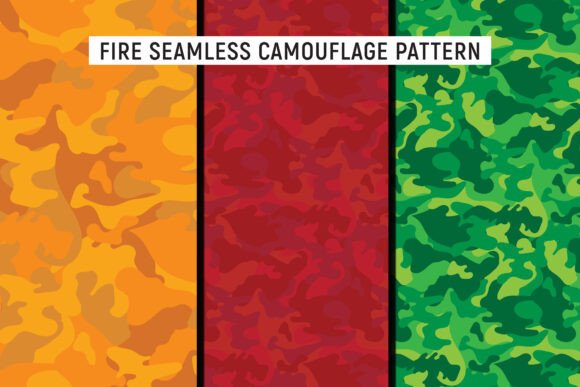
- Color Adaptation: One of the most powerful features of this pattern type is its adaptability. While the default rendering might feature classic greens and oranges, the vector-based nature of many versions allows you to recolor the entire motif to match brand guidelines instantly.
This flexibility is crucial for branding agencies managing multiple clients. A single set of Seamless Fire and Camouflage Patterns can be adapted from a rugged outdoor gear brand's website to a high-energy esports team's merchandise, simply by adjusting the hue and saturation settings. This reduces the need to commission custom illustrations for every new client, saving both time and budget.
Applications in Apparel and Fabric Printing
The fashion industry has long relied on camouflage for tactical aesthetics, but the addition of fire motifs introduces a dynamic tension that resonates with modern consumers. In the context of apparel production, the seamless nature of these patterns is non-negotiable. When printing on fabric rolls, any misalignment results in wasted material and rejected batches.
For small business owners and entrepreneurs entering the streetwear or outdoor sectors, utilizing these patterns offers a competitive edge. The design effectively communicates a narrative of resilience and intensity. When implementing this in a production workflow:
- Mockup Generation: Before committing to a full production run, apply the pattern to 3D mockups of hoodies, jackets, or accessories. This helps stakeholders visualize how the "blazing" elements look on different fabric textures, such as cotton, polyester, or ripstop nylon.
- Sublimation and DTG: Direct-to-Garment (DTG) printers benefit significantly from the high-contrast nature of fire and camo. The dark greens of the camouflage provide a deep background that makes the bright orange and red fire gradients pop, ensuring the final product meets quality control standards.
- Sustainability Considerations: Because the pattern is seamless, there is no need for complex cutting patterns that generate excessive fabric waste. Designers can lay out garment pieces more efficiently on the fabric roll, optimizing material usage and reducing environmental impact.
The result is a garment that feels intentional and premium. It moves beyond the generic "tactical" look often seen in mass-market items, offering a bespoke feel that justifies a higher price point.
Digital Endeavors and User Experience Design
Beyond physical goods, Seamless Fire and Camouflage Patterns play a pivotal role in digital environments. Web developers and UI/UX designers often struggle with backgrounds that are either too plain or too distracting. A static image background can load slowly or pixelate on high-DPI screens, whereas a well-optimized seamless pattern scales perfectly.
Consider a scenario where a blogger or content creator is building a portfolio site. They want a theme that suggests creativity and boldness without overwhelming the reader's ability to consume content. By using the fire and camo pattern as a subtle backdrop with low opacity, the site gains depth and personality. The user experience remains smooth because the pattern acts as a texture rather than a focal point.
In the gaming and esports sectors, this pattern is particularly potent. Streamers and tournament organizers often need overlays, banners, and chat backgrounds that reflect a specific vibe. The combination of natural camouflage and aggressive fire imagery creates a psychological association with strategy and combat readiness. Integrating these assets into OBS (Open Broadcaster Software) or streaming platforms involves setting the pattern as a tileable source. This ensures that regardless of screen size or aspect ratio, the viewer sees a continuous, immersive environment.
Strategic Planning and Brand Consistency
For marketers and business strategists, the decision to adopt a specific visual asset is part of a broader brand architecture. Seamless Fire and Camouflage Patterns should not be viewed in isolation but as part of a cohesive visual identity system. When planning a marketing campaign, consider how this pattern interacts with typography and color palettes.
If your brand voice is authoritative and edgy, this pattern reinforces that message. However, if your target audience is conservative or corporate, the intensity of the fire motif may need to be tempered. This is where the concept of "boldness and subtlety" comes into play. By adjusting the scale of the pattern or the brightness of the fire elements, you can tailor the same asset to fit a luxury streetwear line or a rugged outdoor equipment catalog.
Long-term consistency is key to brand recognition. Once a business decides to incorporate this aesthetic, it should be applied consistently across all touchpoints: social media headers, email signatures, packaging, and physical storefronts. The seamless nature of the pattern ensures that these transitions are fluid. A customer scrolling through an Instagram feed will see the same texture on the profile banner as they do on the product photo, creating a unified brand experience.
Optimizing for Technical Execution
Regardless of the medium, successful implementation requires attention to technical details. Quality control is the final gatekeeper in the workflow. When downloading or sourcing these patterns, verify the file format. Vector formats (like SVG or EPS) are ideal for large-scale printing because they can be resized without loss of quality. Raster formats (like PNG or TIFF) must have sufficient resolution to avoid pixelation.
Furthermore, consider the color space. Digital displays use RGB, while printers use CMYK. The vibrant oranges of the fire motif can sometimes shift when converted for print. Always perform a test print or a soft-proof review before finalizing a project. This step prevents costly errors where the final output lacks the "spellbinding" quality described in the design intent.
Organizational efficiency also plays a role. Keep a dedicated library of these patterns categorized by colorway and density. Tag them appropriately so that team members can quickly locate the right variation for a specific project. This organization reduces the time spent searching for assets and allows the creative team to focus on execution.
The Future of Hybrid Textures
As design trends evolve, the lines between digital and physical continue to blur. Seamless Fire and Camouflage Patterns sit at the intersection of these worlds. They offer a bridge between the organic unpredictability of fire and the calculated order of camouflage. This duality appeals to a demographic that values both heritage and innovation.
Whether you are a freelancer pitching a rebrand, a manufacturer scaling up production, or an educator teaching design principles, understanding how to leverage these hybrid textures is a valuable skill. It demonstrates an ability to blend contrasting elements into a harmonious whole—a metaphor for effective problem-solving in any professional field.
By integrating these patterns thoughtfully into your workflow, you transform ordinary projects into visual masterpieces. The process is straightforward: select the asset, adapt it to your context, and execute with precision. The outcome is a design that not only captures the eye but also stands the test of time in a crowded marketplace.